
When Success Starts Feeling Heavy
You’re performing well.
You’re trusted.
You’re advising senior stakeholders.
From the outside, your career looks solid.
But internally, something feels off.
Not dramatic.
Not catastrophic.
Just… increasingly misaligned.
And then the thought appears:
Either I stay and accept this.
Or I quit everything and start over.
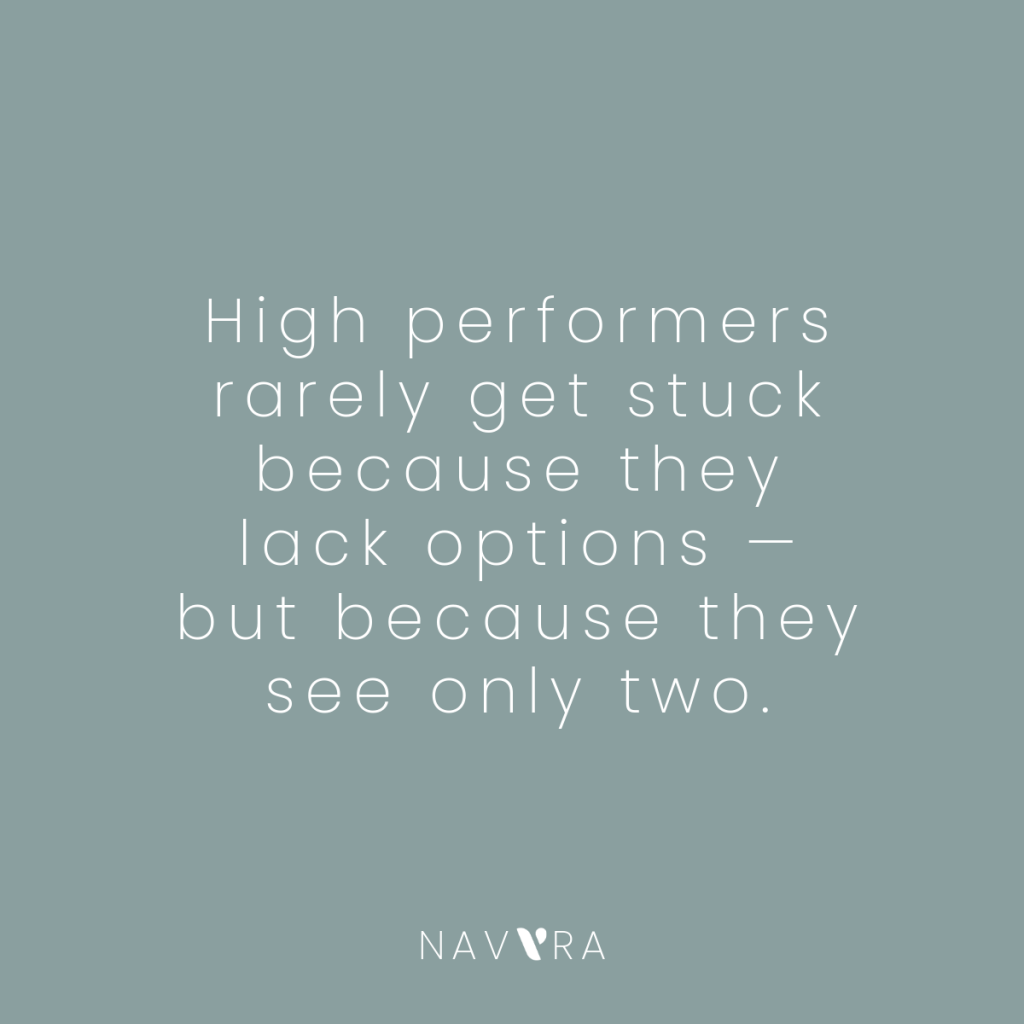
For many high-performing professionals in consulting and leadership roles, this is where the all-or-nothing mindset begins.
The Psychology Behind the Extremes
The all-or-nothing mindset is a form of black-and-white thinking.
Either:
- stay in the draining career
- or burn it down and move to Bali
There is no gray.
Why?
Because your brain prefers clear exits over ambiguous problems.
From an evolutionary perspective, your nervous system is wired to escape discomfort. When tension builds over time — misalignment, overwork, lack of meaning — your brain looks for a fast solution.
Extremes feel decisive.
Gray zones feel uncomfortable.
But decisive is not the same as strategic.
How High Performers Slowly Drift Into It
This mindset rarely appears overnight.
It’s usually a process:
- You ignore small signals of dissatisfaction.
- You compensate with productivity and performance.
- You chase achievement highs that temporarily distract you.
- You normalize chronic stress.
Over time, the internal noise increases.
And because you’re used to solving complex problems for clients or C-suite executives, you expect your own situation to have a clear solution as well.
So you create one:
“All in.”
Or “I’m out.”
But the cost of this binary thinking is paralysis.
Because the distance between those two extremes feels enormous.
The Social Media Illusion: Survivorship Bias
The all-or-nothing mindset is amplified by what you see online.
You see:
- the consultant who quit and built a six-figure business
- the executive who moved abroad and “found freedom”
- the overnight success stories
What you don’t see:
- the financial runway
- the failed attempts
- the years of preparation
- the trade-offs
This is survivorship bias.
You’re shown the winners — not the full data set.
For high-achieving professionals already questioning their direction, these stories create additional pressure:
“If they did it, why am I still here?”
But comparison rarely clarifies alignment.
It usually accelerates emotional decisions.
The Real Risk: Solving the Wrong Problem
When you jump to extremes, you often treat symptoms — not causes.
You might say:
“I need a new country.”
“I need a new industry.”
“I need a completely new life.”
But what if the real issue is:
- chronic overwork
- lack of boundaries
- value misalignment
- identity tied entirely to performance
- lack of recovery
If you don’t understand the root cause, you risk relocating the problem — not resolving it.
Your personality, patterns, and identity travel with you.
Open Problem vs. Closed Answer
Career dissatisfaction is not a closed problem.
It’s an open one.
Open problems require:
- exploration
- curiosity
- experimentation
- iteration
But high-performing professionals are trained to deliver answers quickly.
So instead of exploring the problem, they jump to a solution.
The paradox?
Real clarity often comes from spending time inside the question.
The Alternative: Move From Extreme to Experiment
Instead of:
Quit or stay.
Try:
Test and learn.
One powerful approach is the pilot project mindset.
Rather than redesigning your entire life, carve out 10% of your time — roughly four hours in a 40-hour week — to explore something that matters to you.
This could mean:
- developing a new skill
- exploring a different industry
- starting a small side initiative
- investing in structured reflection
- reconnecting with neglected interests
You’re not escaping your current role.
You’re gathering data.
And data reduces emotional distortion.
Why Small Experiments Work Better Than Big Leaps
When you treat your life like a single high-risk decision, everything becomes fragile.
If the “Bali plan” fails, it feels catastrophic.
When you run experiments:
- feedback is manageable
- learning is continuous
- identity stays stable
- risk becomes proportional
High-performing professionals understand iteration in business strategy.
Apply the same logic to your career.
Test.
Measure.
Adjust.
Energy Audit Before Exit Plan
Before designing an exit, start with clarity.
Ask:
- What consistently drains my energy?
- What reliably restores it?
- Where do I feel expansion instead of contraction?
Many professionals are so used to operating at high intensity that they no longer distinguish between healthy challenge and chronic depletion.
Without that differentiation, every hard phase feels like a sign to quit.
But sometimes the solution is:
- boundary adjustment
- workload redesign
- clearer priorities
- better recovery
Not relocation.
Permission to Experience All Thirds of Life
There’s another misconception behind the all-or-nothing mindset:
The belief that somewhere out there exists a life without friction.
In reality, most lives — even dream careers — contain three parts:
- one third deeply fulfilling
- one third neutral
- one third challenging
The difficult third doesn’t mean you chose wrong.
It means you’re human.
If you expect 100% alignment at all times, every normal difficulty feels like failure.
And failure fuels extremes.
A Strategic Way Forward
If you recognize yourself in this pattern, resist the urge to decide everything at once.
Instead:
- Acknowledge the black-and-white thinking.
- Open the problem before closing it.
- Run small, deliberate experiments.
- Gather real-world data about what energizes you.
- Seek perspective from people who have navigated similar transitions.
Clarity rarely arrives through radical escape.
It usually emerges through structured exploration.
A Thought to Leave You With
The all-or-nothing mindset feels powerful.
But power without reflection is reaction.
You don’t have to burn your life down to change it.
Sometimes the most strategic move — especially for consulting leaders and high-performing professionals — is not a leap.
It’s a test.
Because sustainable direction is built in the gray.
If this resonated, you might want to join The Next Era Edit — a short weekly reflection for ambitious professionals navigating what’s next.
 NAVYRA